


Staff Augmentation vs. Dedicated Teams: Which Model Fits Your Stage
The wrong outsourcing model costs you more than the right model at a higher price point. That sounds counterintuitive, but it’s consistently true. A dedicated team used where staff augmentation was needed creates overhead. Staff augmentation used where a dedicated team was needed creates chaos.
The choice is not about cost. It is about fit.
What each model actually provides
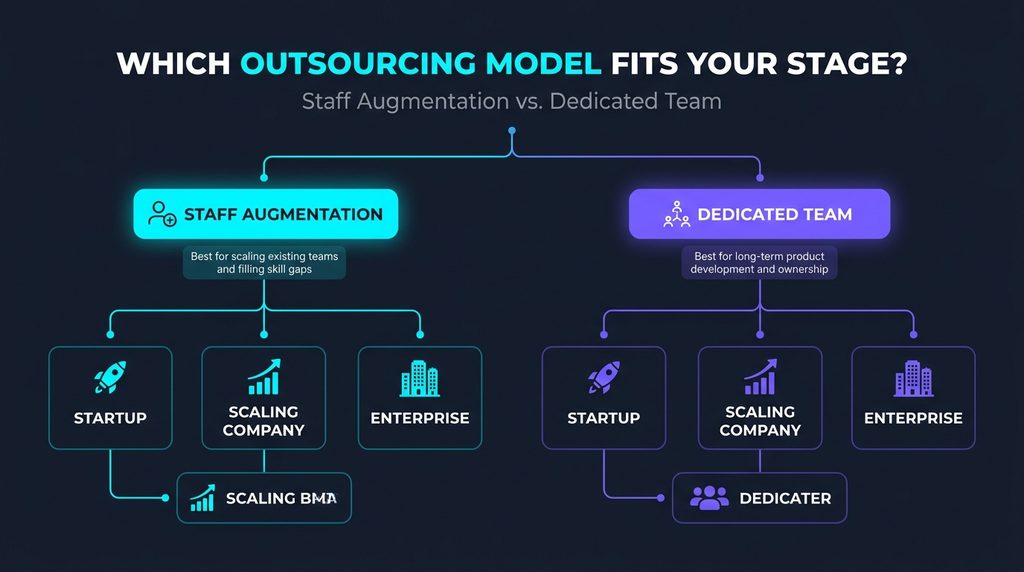
Staff augmentation places individual engineers, designers, or QA specialists inside your existing team structure. They report to your managers, work inside your processes, and fill specific technical gaps. The engagement is typically project-scoped or time-boxed.
A dedicated development team is a standalone unit: engineers, QA, and often a PM, all working exclusively on your product under a shared operational agreement. They do not plug into your team structure. They operate alongside it as a parallel delivery unit.
When staff augmentation is the right choice
Staff augmentation works when your internal team has the right structure and management capacity but lacks specific technical depth or temporary bandwidth. Good signals:
- You need one or two specialists in a technology your team doesn’t cover (Elixir, Swift, or a specific cloud platform).
- You have a defined project with a clear end date and a stable spec.
- Your existing PM and tech lead can absorb new team members without restructuring the operation.
- Speed is secondary to specialist fit.
When a dedicated team is the right choice
The dedicated team model is the right fit when you need delivery capacity that operates autonomously. Good signals:
- You are building a new product or platform that doesn’t have an existing delivery team around it.
- You need to go from zero to a working product in weeks, not months.
- You want engineering knowledge to stay with the team over time, not reset every time a contractor rotates out.
- Your internal leadership is focused on product direction, not engineering management.
Research from Deloitte finds that 70% of organizations outsource primarily to reduce operational costs. But the companies that sustain the greatest benefit from the dedicated team model are the ones that chose it for continuity.
The hybrid approach that works for scaling companies
Introduct regularly works with companies that use both models simultaneously. A dedicated team handles the core product roadmap while staff augmentation covers a short-term technical initiative that doesn’t belong in the main product track. This separation of concerns keeps the dedicated team’s velocity stable while addressing urgent technical needs without disrupting the roadmap.
The key to making the hybrid work is a clear boundary: the augmented engineers should not be routing their decisions through the dedicated team’s PM. Keep the chains of responsibility separate.
💡 Pro tip: If you are debating between models and you can’t articulate who will manage the external engineers on a daily basis, choose the dedicated team model. Management capacity is the resource most founders underestimate when selecting an outsourcing approach.
Find the right model for your team. Introduct offers both staff augmentation and dedicated development teams, structured around your delivery needs rather than a standard contract template. Talk to us about your current stage and what you are trying to build.
More Articles

How to Modernize Legacy Systems: Introduct Guide How to Modernize Legacy Systems: Introduct Guide
A quick example: the system has been running since 2009. Nobody on the current team built it. The documentation is either missing or wrong. And the business can’t stop using it long enough to replace it. This is the starting position for most legacy modernization projects. The risk isn’t that modernization is impossible. The risk […]

AI-Powered Custom Software: What Boards Need to Approve First AI-Powered Custom Software: What Boards Need to Approve First
The development team is ready, the use case is defined, and a vendor is selected. And then the project hits a six-month delay because nobody asked the board who owns the data the AI will be trained on. AI custom software development projects fail at the governance stage more often than the technical stage. The […]