



How to Build a Dedicated Development Team That Actually Ships
You approved the headcount and signed the contract. And a few weeks later, your dedicated development team is producing reports on what they will build next sprint. Nothing has shipped.
This happens more often than most vendors admit. The dedicated team model is genuinely powerful, but it fails in predictable ways. Understanding those failure points before you start is what separates companies that get working software from companies that get impressive-looking status decks.
What a dedicated development team actually is (and isn’t)
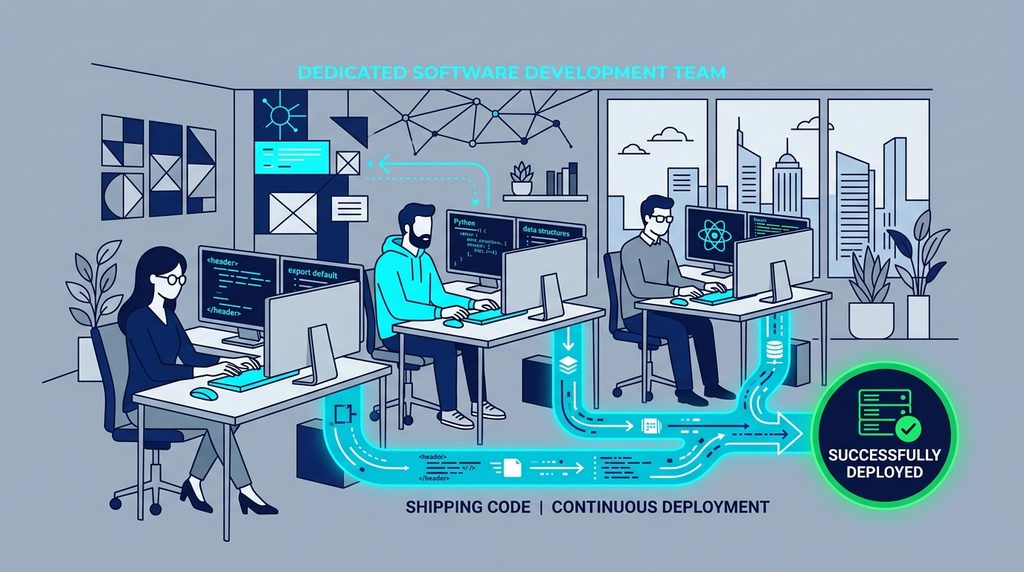
A dedicated development team is a group of engineers, QA specialists, and often a project manager, all working exclusively on your product through an outsourcing partner. They operate on your schedule, under your product direction, without the HR and administrative overhead that comes with in-house hiring.
The model differs from staff augmentation, where individual contractors slot into your existing structure. A dedicated team functions as a standalone unit. That distinction changes how you manage them, how you measure them, and how quickly they can produce results.
According to research from IDC, more than 90% of organizations will face an IT skills shortage by 2026. The dedicated team model exists precisely because the alternative, waiting to hire locally, takes too long and costs too much.
Why dedicated teams stall in month three
Month one is all onboarding energy. Month two is discovery. Month three is where reality sets in, and most teams without a clear delivery structure start producing motion instead of output.
The three most common breakdown points are
- Undefined ownership. When it’s unclear whether the client or the vendor owns the product backlog, both sides fill the gap with meetings rather than decisions.
- Weak technical onboarding. Engineers need access to the right repositories, environments, and documentation on day one, not day fourteen.
- No delivery cadence agreement. Sprint length, demo format, escalation path, and definition of done should be agreed before the first line of code is written.
How Introduct structures dedicated team engagements
At Introduct, we build dedicated development teams ready to operate within one to two weeks. That speed is possible because the pre-engagement process does most of the heavy work: technical alignment, documentation handoff, and role clarity happen before the first sprint begins.
Our teams are structured around a principle we have seen validated across dozens of engagements: a dedicated developer should function as a full member of your team. Your in-house management retains direct oversight. We handle the employer relationship, hardware, and replacement if a team member leaves. You get the productive capacity without the operational complexity.
What to establish in the first two weeks
- Confirm access: repositories, staging environment, project management tools, and communication channels.
- Run one full sprint with daily check-ins to calibrate velocity and surface friction early.
- Set the meeting cadence that will carry the engagement: sprint planning, demos, and async updates.
- Agree on the escalation path if requirements change mid-sprint.
💡 Pro tip: The first sprint should not tackle the most complex feature. Pick something real enough to expose integration issues but small enough to finish in one cycle. That first shipped item builds team trust faster than any kickoff call.
What metrics actually tell you the team is working?
Velocity charts and burndown graphs are easy to manipulate. The metric that matters is how often real software reaches a staging or production environment. If working software ships every sprint, the model is working. If the sprints end with a slide presentation about progress, something needs to change.
Secondary indicators include bug discovery rate trends, time-to-review on pull requests, and how many requirements the team surfaces proactively versus discovers too late.
Build your team with Introduct. Introduct has been building dedicated development teams for companies in Europe, the Middle East, and beyond for a decade. If you are scaling engineering capacity and need a team operational in weeks, reach out and describe your project scope.
More Articles

Zero-Downtime Mainframe Modernization: The Parallel-Run Playbook Zero-Downtime Mainframe Modernization: The Parallel-Run Playbook
A core insurance platform goes down for four hours during a Tuesday cutover. Claims can’t be filed, and underwriting stalls. The modernization project that was supposed to make the company faster instead made the front page of a regulator’s incident log. This is the exact scenario zero-downtime mainframe modernization exists to prevent. And it’s the […]

Software Supply Chain Risk: What CEOs Must Vet Software Supply Chain Risk: What CEOs Must Vet
Your vendor passed every security review you ran. Nobody checked the vendor’s vendor. That gap is what software supply chain risk actually means in 2026. It’s about the trust you extend to companies you’ve never audited. Those companies sit quietly inside the platform your business depends on. The numbers back this up. Veracode’s 2026 State […]