


Imagine a situation: you plan your penetration test two weeks before go-live. The testers find a critical authentication flaw, and fixing it takes three weeks. Your launch slips a month, your customer got the info, and the post-mortem meeting uses the word “avoidable” eleven times.
That scenario played out at a number of well-funded companies in 2025. It didn’t happen because they didn’t care about security. It happened because security lived outside the development process instead of inside it.
What DevSecOps means in plain language
DevSecOps is the practice of integrating security checks, automated tests, and compliance controls directly into the CI/CD pipeline. Security is not a phase that happens after development. It is a property that each commit is evaluated against from the first day of the sprint.
The term “shift left” refers to moving security to the left side of the timeline, earlier in the development cycle, where fixing a problem costs a fraction of what it costs in production. Research from the IBM System Sciences Institute has consistently found that fixing a security defect after deployment costs 15 times more than catching it during development.
What a DevSecOps pipeline looks like in practice
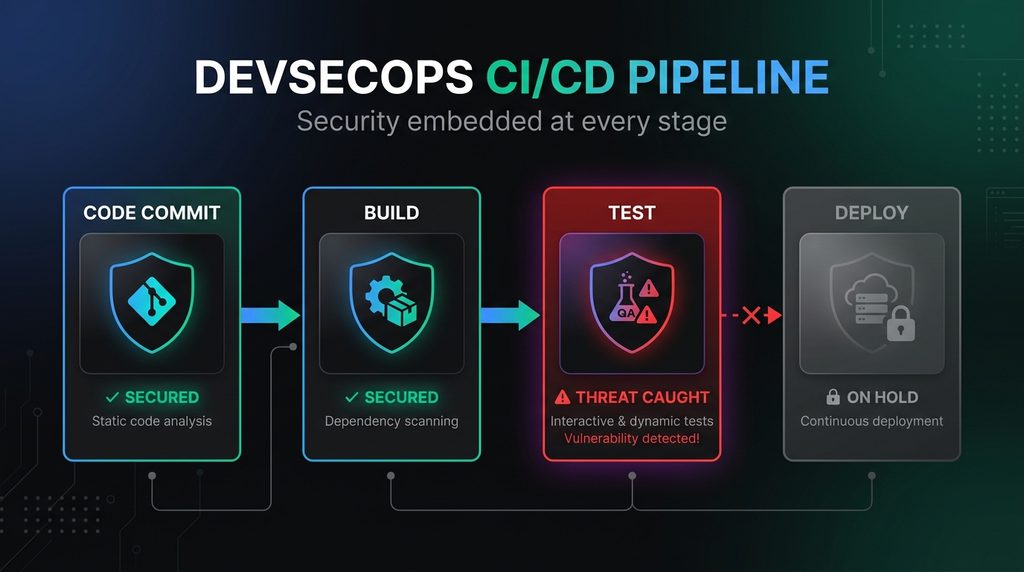
At the code commit stage, static application security testing (SAST) scans each commit for known vulnerability patterns before it merges. At the build stage, dependency scanning checks whether third-party packages carry known CVEs. At the test stage, dynamic application security testing (DAST) runs against a live instance of the application. At deployment, infrastructure-as-code scanning validates that cloud configurations match security baselines.
None of these steps are manual. The pipeline either passes and the code proceeds, or it fails, and the developer receives a specific finding with a remediation reference. No ambiguity, no deferred review.
How this connects to software supply chain risk
A growing share of security incidents in enterprise software trace back to the supply chain: third-party libraries, open-source packages, and infrastructure components that the development team didn’t write and may not have audited. Veracode’s 2026 State of Software Security report found that more than 70% of enterprise applications contain at least one open-source component with a known vulnerability.
DevSecOps addresses this through automated dependency tracking. Every package that enters the build is logged, version-pinned, and checked against current vulnerability databases. When a new CVE is published, the pipeline flags every affected application automatically.
What shifts when DevSecOps is implemented correctly?
The most counterintuitive result is that development gets faster. When you automate and integrate security checks, developers stop context-switching between development tasks and security reviews. They get specific, immediate feedback rather than waiting for a quarterly assessment. The reduction in late-stage rework more than compensates for the time spent embedding the controls.
Over 80% of software teams now use GitHub Copilot. As AI-assisted development accelerates output volume, the case for automated security controls inside the pipeline grows stronger. More code generated faster means more surface area for vulnerabilities introduced at speed.
Start with SAST on every pull request and dependency scanning on every build. These two controls catch the majority of common vulnerabilities and are easily configurable. Add DAST and infrastructure scanning in the next sprint, once the team is comfortable with the first two.
Build security into your delivery process. Introduct builds DevSecOps practices into custom development engagements from the project start. If security is currently a phase in your timeline rather than a property of your pipeline, let’s discuss what it would take to change that.