




Who’s Accountable When Your AI Agent Makes the Wrong Call?

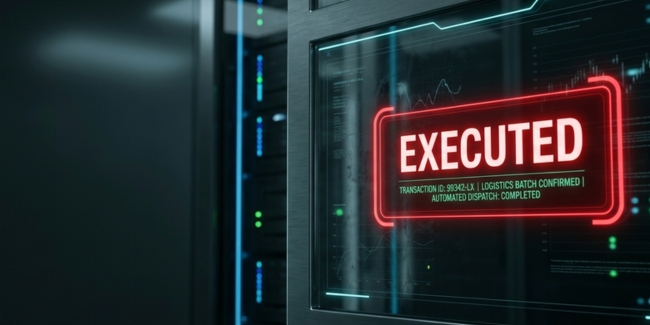
An AI agent approves a shipment against an embargoed port. Nobody signed off on that specific decision. The system had permission to act, and it acted. By Monday morning, the question isn’t why the model made that call. It’s who owns it.
That question is landing on more desks than most founders realize. Gartner projects that 40% of enterprise applications will embed task-specific AI agents by the end of 2026, up from under 5% in 2025. That’s most of the software your company runs on, quietly gaining the ability to act instead of just recommend.
Where “AI helped” turns into “AI decided”
A chatbot that drafts a report still waits for a person to send it. An agent that reprices a policy, releases a payment, or clears a customs exception doesn’t wait. It executes, then reports what it did. The distance between “AI helped” and “AI decided” used to be a design choice. Now it’s often just a configuration setting nobody reviewed carefully enough.
Who is liable when an AI agent makes a bad call?
Legally and financially, it’s whoever authorized the agent’s scope of action, unless the deployment was built to prove otherwise after the fact. That’s the part most companies haven’t tested. Three questions separate the ones who’ll handle this well from the ones who’ll end up explaining a bad decision to their board.
1️⃣ What is this agent actually authorized to do without a person in the loop? Most executives can’t answer that precisely for systems already running in their business.
2️⃣ If something goes wrong, you need more than the output. You need the reasoning behind it, the data it used, and the exact moment it acted.
3️⃣ What specifically triggers escalation to a human? “When something looks wrong” is not an answer. It needs a threshold, written down, tested.
What accountable-by-design actually looks like
We’ve built systems that had to answer these questions from day one, because the environment gave no room for improvisation. In regulated software delivery for finance, a system that scores taxpayer behavior and triggers fines and notifications directly is making decisions with real financial and legal weight, without a person reviewing each one individually.
That’s what an audit-ready regulated system has to be built for. Insurance is no different: running core systems on a 2-hour recovery-time SLA, 24/7, in a market where regulators expect systems to hold up under audit, not just under load, means custom AI-integrated software development has to have accountability designed in from day one. Neither environment tolerates a system that acts and can’t explain itself later.
What to ask this week
The companies moving fastest on agentic AI right now aren’t the ones still asking whether to deploy it. They’re the ones who already know exactly what their agents are authorized to do, and who gets called when one of them gets it wrong. If you can’t answer both for the systems already running in your company, that’s this week’s meeting, not next quarter’s. Introduct builds systems where that answer is ready before anyone asks.
More Articles

The 3-Month Wall: Why “Vibe Coding” Breaks Your Codebase The 3-Month Wall: Why “Vibe Coding” Breaks Your Codebase
The tech industry is fully immersed in the era of vibe coding. Many companies and developers rely fully on these tools. But can we really trust them? AI-driven development engines like Windsurf and Cursor offer a lot of opportunities. Now, devs don’t need to spend weeks coding. Instead, there are just a couple of hours, […]

The Emperor’s New Code: Why Vibe Coding is Speedrunning Your Technical Debt The Emperor’s New Code: Why Vibe Coding is Speedrunning Your Technical Debt
Building a web app by just talking to a computer feels like a shortcut. No syntax errors, no manual debugging, and no need to understand how Python or React actually work. This is “vibe coding” – a trend popularized by Andrej Karpathy. For a founder trying to get a prototype up in a weekend, it […]