




Working in Oman: What Tech Professionals Really Want to Know Before They Move
Every week, someone asks us a version of the same question. The questions are not about the salary or the tech stack. It’s simpler and harder than that: What is it actually like to live in Oman?
Moving to a country you have never visited, sometimes with your family, is not a small decision. Generic reassurances don’t help. So instead of telling you what we think you want to hear, we collected answers from the people who already made this move.
Today we cover the first three answers. Here is what they told us.

What Happens the Moment You Land in Muscat
The first thing most people notice is the heat. Volodymyr Herchuk, a software engineer from Ukraine, described his first weeks with characteristic honesty:
“HOT, and I had no desire to leave the hotel room and face the sun or the desert streets,” – Volodymyr Herchuk, Ukraine.
That is the real picture. Muscat in summer is genuinely hot. Most colleagues say it takes about two weeks before your body stops fighting the climate and starts adapting to it. It does get easier. But the first week, you will feel it.
What Introduct does immediately is remove the logistical weight from that first period. Hotel accommodation for the first two weeks is standard. Document processing, residency paperwork, and visa support all start from day one. Volodymyr also received a shared car, which he described as essential for exploring the city beyond walking distance.
Ilyas Zhuanyshev, a backend engineer who relocated from Kazakhstan, gave us the most specific list of what the company handled during his first weeks: hotel stay, apartment rental, Oman ID card, medical check-up, residency registration, bank account opening, and a driver’s license. That is most of the bureaucratic work a new resident faces, removed before he had to face it alone.
💡 Practical note for candidates: If you are exploring a role in the Oman office and want to speak directly to someone who has already been through this process, ask your recruiter. We make that introduction.
What Daily Life in Muscat Is Actually Like
Safety comes up in every answer without being prompted. Muscat consistently ranks among the safest cities in the Middle East, and the people who live there describe it as something you feel in daily life.
Ilyas gave us the best illustration of this. During his first week, he went to a restaurant and realized he had left his credit card at the hotel. He only had US dollars. The restaurant only accepted Omani rials. He offered to leave dollars as a deposit.
“They said, ‘No worries, we trust you. Come back tomorrow and pay in rials. ‘I was shocked that they would trust a stranger like that. It shows how much people here trust each other,” – Ilyas Zhuanyshev, Kazakhstan
He went back that same night to pay. But the point stands: this is not a city where you feel watched or pressured. It is calm in a way that takes some people time to adjust to, especially those coming from high-paced urban environments.
Food and Cost of Living
Multiple colleagues mentioned, without being asked, that restaurants are inexpensive and the food is excellent. Volodymyr eats out several times a week and spent his first weeks working through Egyptian, Omani, Yemeni, and Turkish options. Ilyas noted that both restaurants and supermarkets are notably cheaper than what he paid in Kazakhstan.
Ali Najafli, who relocated from Azerbaijan, summarized the overall atmosphere simply: “Muscat is safe, peaceful, and welcoming. People are friendly and respectful.“
Relocating with Your Family
Ali’s answer to how they adjusted is worth reading for anyone in the same situation:
“Moving to a new country takes time, especially when adapting to a different environment, culture, and daily routine. Fortunately, Muscat is a safe and family-friendly city, and people are welcoming, which makes settling in easier. The weather can be quite hot, but overall, it’s a good place to live and build a comfortable life.” – Ali Najafli, Azerbaijan
International schools in Muscat serve a large expat population. Healthcare is accessible and well-regarded. The city’s low crime rate means families with children describe it as genuinely relaxed, not the performance of safety you get in some cities.
The Work Itself
Introduct is a technology company building national tax infrastructure for the Sultanate of Oman. The scale of that project is real. Engineers here work on systems that will process millions of transactions for an entire country’s revenue authority.
Ali described his professional experience directly: “It has allowed me to work on challenging infrastructure projects, gain hands-on experience with OpenShift, and strengthen my technical skills.”
These are not maintenance projects or internal tools. They are foundational systems, and people who work on them grow faster than they would in most other environments.
You can read more about the technical environment and current open roles on our careers page or learn about how we develop engineers at Introduct Academy.
What Surprised People Most
We asked everyone the same question: what surprised you most about living in Oman? The answers point to one pattern.
The calm surprised people. Not the physical landscape, though that is genuinely beautiful. Ilyas described Omani people as “the calmest and friendliest I’ve ever met” across several countries he had lived in as a student. He mentioned traffic as a small but telling example: drivers in Muscat are patient. When you need to merge or turn, people let you. Nobody honks.
Ali, who came from Azerbaijan, was surprised by how quickly everyday professional growth happened: working on infrastructure at national scale, with a team spanning five countries, moves your skills forward in ways that slower-paced projects simply do not.
The team at the Introduct Oman delivery center currently includes people from Ukraine, Azerbaijan, Kazakhstan, Georgia, and Oman. That mix shapes the culture of the office in ways that are hard to describe in a job listing but easy to feel on day one.
More Articles
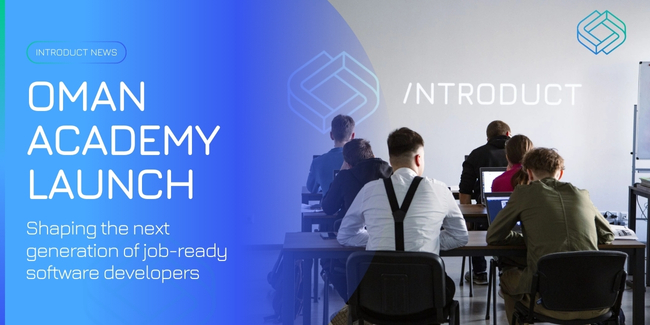
Introduct Expands into Oman with New Software Development Academy Introduct Expands into Oman with New Software Development Academy
At Introduct, we care about nurturing technical talent and providing tailored software solutions across the globe. In this regard, we’re glad to present to you the launch of Introduct Academy in Oman in 2026! The Oman Academy marks a significant step forward in our operation. In our news article, we’re about to go deeper into […]

Introduct Expands to Oman to Strengthen Innovation and Digital Growth Introduct Expands to Oman to Strengthen Innovation and Digital Growth
We are happy to announce the opening of new Introduct operations in Oman! For us, it’s a big step forward, symbolizing that we expand our work and growth in the Middle East, bringing our expertise in developing tailored software solutions. This partnership starts a new era of innovation, supporting local talents and driving digital transformation […]